



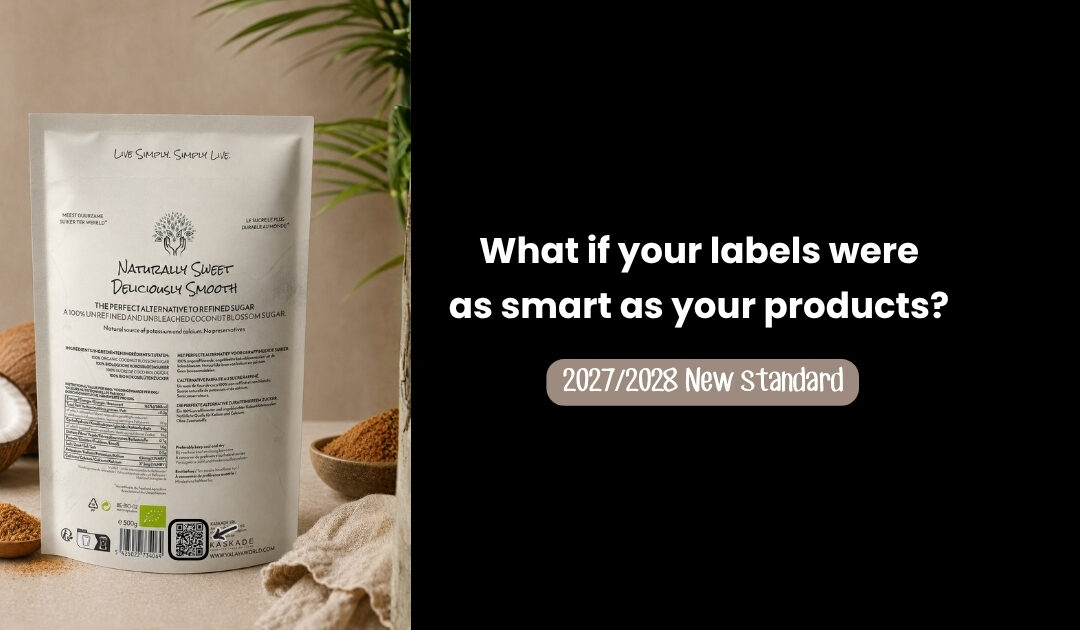
What if your labels finally became as smart as your products?
By the end of 2027, all point-of-sale systems in Europe will be required to be able to read 2D codes in addition to traditional barcodes. And starting in 2028, manufacturers will even be able to replace the old linear barcode with a single 2D code on their packaging.
It’s not a rumor—it’s the new standard. And it’s going to change the way your products communicate—on the shelf, in the warehouse, and beyond.
What's changing in practice
Less code, more info
Today, a typical package may feature an EAN barcode, a marketing QR code, an organic logo, a recycling symbol… A veritable forest of symbols. With the transition to GS1 2D codes, a single code can replace some of these elements (particularly the various codes), even though certain logos will still be necessary (certifications, claims, recycling, etc.).
This 2D code can contain much more information than a traditional barcode (depending on your industry, products, and systems): batch information, safety information, anti-counterfeiting measures, and more…
A gateway to the digital world
But the true potential of 2D barcodes goes far beyond the checkout. Thanks to GS1 Digital Link technology, a simple scan with a smartphone can provide access to:
- Detailed and up-to-date product descriptions
- Recipes, instructions, or nutrition guides
- Targeted promotions
- Certifications (organic, fair trade, origin, etc.)
- A digital passport (to be issued in accordance with upcoming European regulations)
- Recycling information tailored to the consumer's municipality
- A direct channel for customer feedback
In short: Your packaging becomes a constant digital touchpoint with your customers.
Why not wait until 2027 to get started?
The deadline may seem far off, but the transition doesn't happen overnight. It involves:
- A redesign of your labels and packaging design guidelines
- An update to your systems (ERP, warehouse management, traceability tools)
- Coordination with your printers, distributors, and retail partners
- A clear data strategy: What information should be embedded in the code, and for what purpose?
Companies that act early will have a clear competitive advantage: packaging that is already compliant, an optimized supply chain, and packaging marketing that creates value rather than being a burden.
What Kaskade is already doing
At Kaskade, we don’t want to wait until the 2027/2028 deadline. We’ve decided to get a head start —and to support our customers through this transition.
Here is what we are proposing in concrete terms:
1. Audit of existing labels
We review all of your current labels and all the codes they contain (1D barcodes, marketing QR codes, labels, certification logos, etc.). The goal is to identify which elements can be consolidated, simplified, and migrated to a single 2D code.
2. Data Strategy
What data should you include in your 2D code? The answer depends on your business. Supply chain, quality, marketing, CSR… We help you define a clear strategy without complicating your teams’ day-to-day work.
3. Transition Support
We’ll guide you step by step through the transition to GS1 2D codes (Digital Link), taking into account the period during which the old 1D barcodes and the new 2D codes will coexist. No sudden, drastic changes: a gradual, controlled migration.
The result?
- Our teams are ready for the new standard—no last-minute stress.
- Our packaging is already designed with the future in mind.
- We turn a technical challenge into a business and marketing opportunity.
And you, how are you doing?
Labels are changing. The question is: are you just going along with them… or are you using them to get a head start?